
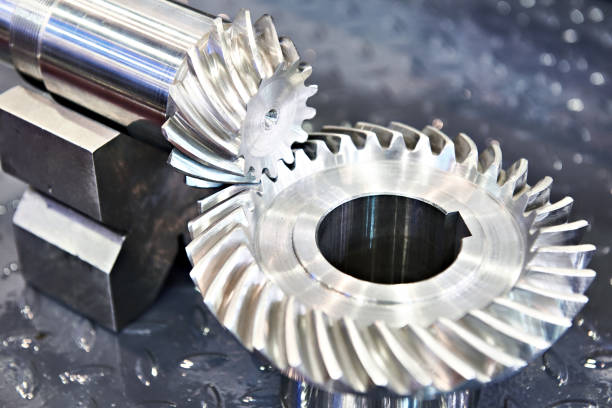

I was fixing my old oscillating fan the other day—yeah, the kind your grandpa probably had—and while I was fiddling around, trying to figure out why it wasn’t swinging side to side anymore, I stumbled upon a strange little gear. At first glance, it looked like someone had bent the teeth sideways. Turns out, it wasn’t broken. It was a bevel gear. That small discovery sent me down a rabbit hole—one that led to a fascinating world of motion mechanics and thermal devices we rarely think about, but totally rely on.
So, what follows isn’t just a rundown of technical details. It’s a peek into how these underrated components shape our lives. This isn’t textbook jargon—just a real-world look at gears, modules, and a few “Aha!” moments along the way.
From Curiosity to Gearhead
You ever notice how a drill can change the direction of motion, like the handle rotates one way and the drill bit spins in another plane entirely? That’s bevel gear magic. These gears are designed with angled teeth, typically mounted on shafts that are 90 degrees apart. What’s wild is how often they show up in machinery you’d never even notice—like the power steering system in your car or the gearbox in a manual transmission.
They’re kind of the unsung heroes of angled motion. And believe me, once you notice them, you start seeing them everywhere. In lawn mowers, printing presses, even in mechanical clocks. What makes a bevel gear so nifty is that it changes the axis of rotation—almost like turning a corner without losing speed or torque.
The geek in me couldn’t help but admire the precision. These aren’t just pieces of metal with teeth—they’re sculpted for performance. The angle, the size, the load capacity—it all matters. If even one tooth is off, you’re in for a world of squeaks, jams, or worse, total mechanical failure.
Heat Transfer Isn’t Always About Fire
Okay, so while I was busy exploring gears, I stumbled into another rabbit hole. It began with a YouTube video where someone cooled a soda can using what looked like a small computer chip. No fan, no ice, no magic. Just a tiny device called a peltier module.
Let me paint the picture. You plug it in, and within seconds, one side gets icy cold, and the other gets too hot to touch. No moving parts. No refrigerants. Just solid-state thermoelectric wizardry.
I couldn’t believe it, so I bought one off Amazon and ran a few tests. It felt like sci-fi. A device smaller than a playing card could chill water. It works using something called the Peltier effect—where an electric current causes heat to move from one side of a material to another. And boom, you’ve got a portable cooler, heater, or temperature regulator, depending on how you set it up.
The genius of the peltier module isn’t just in its simplicity—it’s in how incredibly versatile it is. These modules are used in car seat climate control systems, mini-fridges, wine coolers, and even CPU coolers for custom-built PCs. They’re not as efficient as compressor-based refrigeration systems, but in applications where size, noise, or precision matters, they’re a solid win.
Tinker Time and Trial & Error
Now, full disclosure: I’m no engineer. Just a curious mind with a toolbox and Wi-Fi. But playing around with these components—gears and thermoelectric modules—gave me a new kind of appreciation for how design and physics blend.
My DIY experiments weren’t perfect. The first time I hooked up a peltier, I reversed the polarity and thought I broke it. It just wasn’t doing anything—no heat, no cool. Turns out, I just had the wires flipped. The moment I got it right, that tiny square buzzed to life, one side frosting up in my palm while the other scorched like a forgotten pizza stone.
Gears, on the other hand, are a lesson in patience. Getting a bevel gear to mesh smoothly with its mate is all about spacing and alignment. Too far, and the teeth skip. Too close, and it binds. Every adjustment felt like a mini physics lesson. Friction, torque, gear ratio—all concepts that suddenly made sense when applied with my own hands.
When These Things Actually Matter
Now here’s the real kicker. While they might sound like niche tools or parts for engineers to play with, bevel gears and peltier modules are a part of so many real-world problems and solutions.
Let’s say you’re designing a compact robot—like the kind that zips under couches and vacuums your floor. Those tiny gearboxes? They need bevel gears to steer and change motion direction in a tight footprint.
Or say you’re developing portable medical equipment for remote locations. No power grid, no refrigeration—how do you keep vaccines at the right temperature? A small, battery-powered unit using a peltier module could be the answer.
Even in astronomy, where telescopes need micro-movements with precision, bevel gears are part of the movement mechanisms. And temperature control? You bet those sensitive electronics benefit from Peltier cooling.
The Beauty of Silent Workhorses
There’s something poetic about components that do their job without drawing attention. No one oohs and aahs over a gear, or points excitedly at a heat sink. But without them, nothing works.
I once cracked open an old DSLR camera lens. Inside, a perfect array of tiny gears shifted to zoom and focus. That’s when it hit me: we’re surrounded by marvels we never give credit to.
The fan in your laptop, the HVAC system in your car, the prosthetics that give someone back their independence—they all lean on basic mechanical and thermodynamic principles. And tucked within? Gears, modules, and devices that keep things humming.
Innovation Isn’t Always Loud
Let’s be honest, we live in a tech-obsessed world. AI, blockchain, quantum computing—they hog the headlines. But innovations like bevel gears or thermoelectric modules? They’re quiet. Practical. Proven. And they keep evolving.
Today’s bevel gears are being made with new composite materials to reduce weight and noise. Meanwhile, peltier modules are becoming more efficient thanks to nano-material research and layered thermocouple designs.
You’ll even find these modules in space tech, keeping sensors and instruments at just the right temperature on satellites and rovers. Imagine that—a tiny square chip regulating the temperature of million-dollar equipment floating in orbit. That’s next-level useful.
What It All Means
This journey—starting from a broken fan and ending in an understanding of thermal dynamics—wasn’t really about becoming a mechanical wizard. It was about realizing that the world isn’t run by massive breakthroughs alone. It’s also powered by small, elegant solutions. Simple devices that get the job done, day after day.
We tend to overlook the “invisible” parts of innovation. But the deeper I dove, the more I appreciated the thought, care, and engineering genius that goes into the components most of us will never notice.
Tinkering as a Way of Seeing
I know it sounds cheesy, but I really believe more people should tinker. Just take something apart. Look at what’s inside. Try to fix it, even if you fail. Especially if you fail. There’s a sort of joy in wrestling with physical things—of translating theory into touch.
Whether it’s the mesmerizing meshing of a bevel gear or the instant chill from a peltier module, these devices teach us that technology doesn’t always need to be loud or flashy to be brilliant.
And maybe that’s the takeaway here: Brilliance often hums quietly in the background. Like the steady turn of a gear or the slow shift of heat from one side to another—unseen, but essential.
Final Thoughts from a Curious Mind
So if you’ve made it this far, maybe now you’ll look at everyday objects a little differently. Maybe you’ll take apart a broken toy, a fan, an old coffee machine—and notice the craftsmanship hiding within.
Don’t get caught up thinking that tech is all screens and apps. Sometimes, the most impressive parts are the ones you’ll never see unless you dig a little.
And hey, next time you enjoy the perfectly angled movement of a machine, or feel the cooling blast from a silent fridge drawer, give a little mental nod to the humble components that made it possible.
Because chances are, it wasn’t just software. It was a gear, a chip, or a bit of science quietly doing its thing—with elegance, purpose, and a surprising amount of personality.